
Having recently upgraded to a Canon 40D, an excellent piece of kit, I have been exploring the Automatic Depth of Field exposure option (A-DEP). While I understand at a basic level what the camera is doing (stopping down to accommodate near and far in the auto focus area) can anyone say how this relates to the hyperfocal distance concept? Is it likely that by using this exposure setting, a hyperfocal distance is being set by default? If it is, then for practical purposes, the need to work out or even care about hyperfocal distances is obviated. If it isn't then it's back to that tutorial!
David
 Helpful Posts: 0
Results 1 to 6 of 6
Thread: Automatic Depth of Field (A-DEP)
-
2nd May 2008, 11:59 AM #1


- Join Date
- Apr 2008
- Location
- Cheshire and Dumfries & Galloway
- Posts
- 732
- Real Name
- David
Automatic Depth of Field (A-DEP)
-
2nd May 2008, 05:25 PM #2Administrator
- Join Date
- Apr 2008
- Location
- California, USA
- Posts
- 1,473
- Real Name
- Sean
Re: Automatic Depth of Field (A-DEP)
Canon's auto depth of field (A-DEP) feature works by (1) finding the nearest and furthest of all the autofocus points, (2) setting the camera's focusing distance to optimally position the depth of field between these nearest and furthest points, and (3) setting the aperture so that the edges of the depth of field extend far enough to contain these nearest and furthest points.
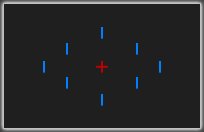
sample autofocus point array for the Canon EOS 40D
The auto depth of field feature is most useful for group photos where you would want everyone in sharp focus, but do not necessarily want to use such a small aperture that it causes the background to become sharp. On the other hand, A-DEP's biggest problem is that it uses all of the camera's autofocus points-- which are quite often uncontrollably placed across the your subject and background. It is primarily for this reason that many photographer's complain about A-DEP or never use the feature at all.
Using A-DEP is different from setting the camera/lens to the hyperfocal distance because the furthest edge of the depth of field does not necessarily extend all the way to infinity (as would be the case in a landscape shot, for example). Often times the hyperfocal distance is not ideal for situations with primarily foreground subject matter or indoors, which is where A-DEP happens to prove most useful. A-DEP is really a custom hyperfocal distance for a given set of near/far subject distances.
It is also worth mentioning that ever since the Canon EOS 1D, Canon has dropped the A-DEP feature from it's professional 1-series cameras.
-
2nd May 2008, 08:27 PM #3

- Join Date
- Apr 2008
- Location
- Raleigh (NC/US), Paris
- Posts
- 183
Re: Automatic Depth of Field (A-DEP)
I bought a rebelXT like 3 years ago, and previously owned a regular Canon A2E (not a professional but needed faster shutter speed for sports, etc...)
it used to have a great A_DEP setting: choose first point, then second, reframe, and shoot.
now the digitals seem to have a one shot only kind of setting, which in my opinion doesn't work as well ( at least not flexible)....just sad...
I wonder if higher ends canon are still using the old fashion A_dep feature
-
5th May 2008, 12:19 AM #4

- Join Date
- Apr 2008
- Location
- Philadelphia
- Posts
- 93
- Real Name
- Elie
Re: Automatic Depth of Field (A-DEP)
Interesting. Originally Posted by McQ

Did they go back to the old non-automatic DEP or just excluded it altogether?
I kinda like this feature, and I think it helps a lot to lock the exposure in Manual with the suggested aperture / shutter combination just prior to recomposing.
-
9th May 2008, 06:05 AM #5Administrator
- Join Date
- Apr 2008
- Location
- California, USA
- Posts
- 1,473
- Real Name
- Sean
Re: Automatic Depth of Field (A-DEP)
I believe that both the A-DEP and DEP features have been excluded from recent 1-series Canon models altogether.
-
19th May 2008, 09:02 PM #6
- Join Date
- May 2008
- Location
- Seattle
- Posts
- 10
Re: Automatic Depth of Field (A-DEP)
I would be very careful with A-DEP...and certainly don't use it without practice so you can determine exactly how it works and what the results will be. I ruined a whole trip worth of photos because I assumed I knew how it was going to work...
Brian

 Reply With Quote