
Hi to all,
I'm a newbie in digital photography and I'm confused about the inch based system of sensor sizes. According to some websites, it is a standard related with video tubes and it defines the outer diameter of tube glasses. In digital photoraphy, it is always greater than the diagonal of the sensor and it is defined as the diameter of the imaging circle. In this case, why are we using it as a measure of sensor sizes? The diameter of the imaging circle may be related with lens or any other thing, I don't know, but I think that it should not be related with the size of a sensor. Am I wrong?
I'm sorry for poor English, by the way ...
Thanks.
 Helpful Posts: 0
Results 1 to 4 of 4
-
22nd April 2008, 10:34 PM #1New Member

- Join Date
- Apr 2008
- Posts
- 3
Inch-based system of naming camera sensor types
-
22nd April 2008, 11:27 PM #2Administrator
- Join Date
- Apr 2008
- Location
- California, USA
- Posts
- 1,473
- Real Name
- Sean
Re: Inch-based system of naming camera sensor types
Yes, it is quite a confusing naming convention. You are right that this is in part an artifact of old video tubes. In the case of digital cameras, this diameter corresponds closely with the diameter of the imaging circle projected onto and around the sensor, such as 1/1.8", 1/2.5", 2/3", 4/3", etc. Here's an example of what this circle looks like:
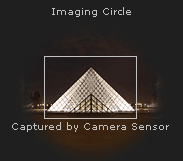
From the above picture you can see that the diameter of this imaging circle is close to the diameter of the sensor, but a little bigger. This is because image quality drops off drastically as you get near the edge of this image circle, so you want to avoid capturing image information from here if you can. Also notice that this imaging circle has a gradual fade-out; the inch convention for measuring it's width is therefore not a strict measure, but instead represents a standardized/characteristic width (which is useful for comparing the size of one imaging circle to another).
There's one big advantage to convention of describing a camera sensor in terms of its imaging circle: it is aspect ratio independent. The current convention is therefore more a descriptor of the size of lenses required and the impact of aperture on depth of field for a given camera (as opposed to strict sensor size). If we instead used the sensor's diameter or its diagonal, a camera with a 4:3 aspect ratio (such as most compact digital cameras) would have a different size than a camera with a 3:2 aspect ratio (such as most digital SLR cameras)...even if the imaging circles were the same size, and the cameras used the same lenses.
You are right though, many people confuse the two terms. Saying a camera has a 1/1.8", 1/2.5", 4/3" etc. digital sensor size is definitely misleading, even though this is often times what people say or write. They should instead say it has a 1/1.8" or 1/2.5" *imaging circle*.
Overall though, the size of the imaging circle does roughly correlate with the size of the sensor, so in that sense it is not completely wrong. Only when you are comparing different aspect ratio sensors does it become inconsistent...
-
23rd April 2008, 12:28 AM #3New Member
- Join Date
- Apr 2008
- Posts
- 3
Re: Inch-based system of naming camera sensor types
I thought the diameter of imaging circle as a variable which is dependent only on the lenses not on the sensor sizes, but it seems that for a given sensor size, according to this page on sensor sizes, there is approximately same imaging circle we get, as you said. The page says that "There appears to be no specific mathematical relationship between the diameter of the imaging circle and the sensor size, although it is always roughly two thirds."
Maybe, the relationship is reverse. That is, for a given imaging circle by the camera, there must be a sensor suitable for it ... that is, imaging circle setting by the camera draws the upper border of the sizes of sensor.
Thank you.
-
23rd April 2008, 03:33 AM #4Administrator
- Join Date
- Apr 2008
- Location
- California, USA
- Posts
- 1,473
- Real Name
- Sean
Re: Inch-based system of naming camera sensor types
Yes, we're getting into a bit of a chicken and the egg problem here

Regardless, the imaging circle has to always be a bit larger than the camera's sensor diagonal. Beyond that, it really comes down to a quesiton of design and manufacturing. Namely, whether sensor size is designed to suit a pre-determined lens/imaging circle, or whether the lens/imaging circle is designed to suit a pre-determined sensor size.
Of course, all of this excludes another entirely different imaging circle / sensor size relationship: that encountered with tilt shift lenses, particularly for the use of controlling perspective.

 Reply With Quote