
I just tried your DOF calculator and was somewhat surprised to see that smaller sensors do give less DOF than the larger ones. For 35mm format F2/200m/10 meters gives 0.647 meters of total depth of field, whereas 1.5x gives only 0.431 meters. I think it is written somewhere in between the lines which I am not able to catch. Could you expand on why exactly it is so?
-
 Helpful Posts: 0
Results 1 to 7 of 7
Thread: Calculating Depth Of Field
-
30th June 2008, 06:58 AM #1New Member

- Join Date
- Jun 2008
- Posts
- 6
Calculating Depth Of Field
-
30th June 2008, 03:06 PM #2New Member
- Join Date
- Jun 2008
- Posts
- 6
Re: Calculating Depth Of Field
Changing the format changes the degree of enlargement. Since you have to enlarge a smaller format more, there is less DOF. On the other hand, you have changed the composition inasmuch as the field of view (FOV) has changed; therefore, to keep the composition equivalent you need to use a different focal length.
Lets consider 200mm 135 film (aka, "Full frame" or FX) format the baseline -- that's a 10.3°x6.9° FOV. To get the same FOV with DX format, you need a 133mm focal length. Substitute the DX focal length for the 135 film format focal length and now you will see a greater DOF for the DX format. The equivalent DOF and perspective for 135 film format at 200mmm and f/2 for DX format ends up being 133mm and f/1.32.
-
30th June 2008, 05:15 PM #3

- Join Date
- Jun 2008
- Posts
- 13
Re: Calculating Depth Of Field
Apart from the theory, you can also just to an experiment with two camera's at the same position, having the same angle of view and photographing a measuring tape. Here you see, that it is the other way around: compact camera gives more DOF than fullframe, which is in agreement with my Graphic Depth of Field Calculator (click here)
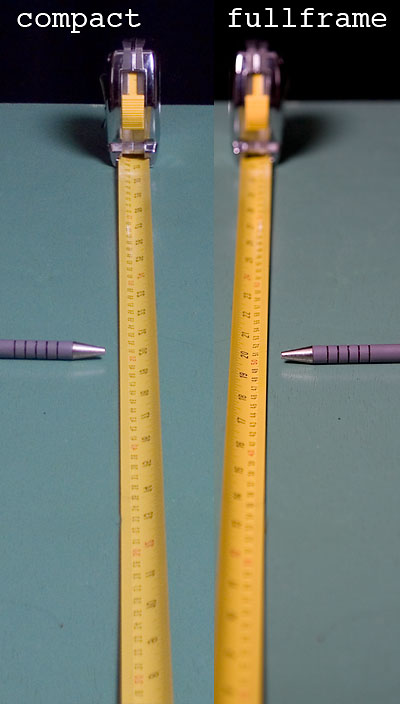
When you change to a smaller sensor size, you also have to adjust the focal length to a shorter length, to keep the angle of view the same. Only then you compare sensor size without including a variable angle of view.
Perhaps this helps to solve the misunderstanding.Last edited by Lindolfi; 30th June 2008 at 05:18 PM.
-
3rd July 2008, 08:43 AM #4New Member
- Join Date
- Jun 2008
- Posts
- 6
Re: Calculating Depth Of Field
Thanks Tony. I just tried in this calculator, Originally Posted by TonyBeach

https://www.cambridgeincolour.com/tu...h-of-field.htm
I select 50/1.4 lens on 1.5x crop camera. The total dof is calculated as 0.096 m
I select 50/1.4 lens on 35mm format camera. The total dof is calculated as 0.144 m
As you see with the same identical lens the calculated total dof is larger from the 35mm and not 1.5x crop camera. Should not it be the other way?
Now you are saying the degree of magnification does effect perceivable dof, it sounds very reasonable, but does the calculator take magnification into consideration or are there other variables involved as well?Last edited by Chello; 3rd July 2008 at 08:46 AM.
-
3rd July 2008, 04:55 PM #5
- Join Date
- Jun 2008
- Posts
- 13
Re: Calculating Depth Of Field
When you use a 50 mm lens on a 1.5 crop camera, you have to compare with a 75 mm lens on a 35 mm format camera to get the same angle of view. Only then you can compare the dof and you will find that it is the other way around: Originally Posted by Chello
50/1.4 lens on 1.5x crop camera with f1.4 and 2 meter focus distance gives dof=0.096
75/1.4 lens on 35 mm format cam. with f1.4 and 2 meter focus distance gives dof=0.063
As you can see, the smaller sensor gives the larger dof.
-
4th July 2008, 06:03 AM #6New Member
- Join Date
- Jun 2008
- Posts
- 6
Re: Calculating Depth Of Field
This is correct, and we all know that. Does the calculator take it into consideration? It does not ask me whether I want to compare equal angle of view, it only asks for the format, focal length, distance, and the aperture. So my question is, why do I get deeper dof for 35mm format than for the smaller 1.5x crop camera when at the same settings? Originally Posted by Lindolfi
-
4th July 2008, 02:23 PM #7
- Join Date
- Jun 2008
- Posts
- 13
Re: Calculating Depth Of Field
[1] at a constant sensor size, DOF becomes a quarter of what it was, when you double focal length.
[2] at a constant focal length, DOF doubles when you double the sensor size
[3] when you keep the ratio of focal length to sensor size constant, dof is halved when the sensor size doubled
When you look at points [1], [2], and after that to [3], it makes sense: focal length is a more powerful factor than sensor size, so a linear inverse relation is maintained in [3]
Now, the reason that focal length has an inverse quadratic relation with DOF, is because the focal plane moves four times more when you double focal length at any given movement of the object:
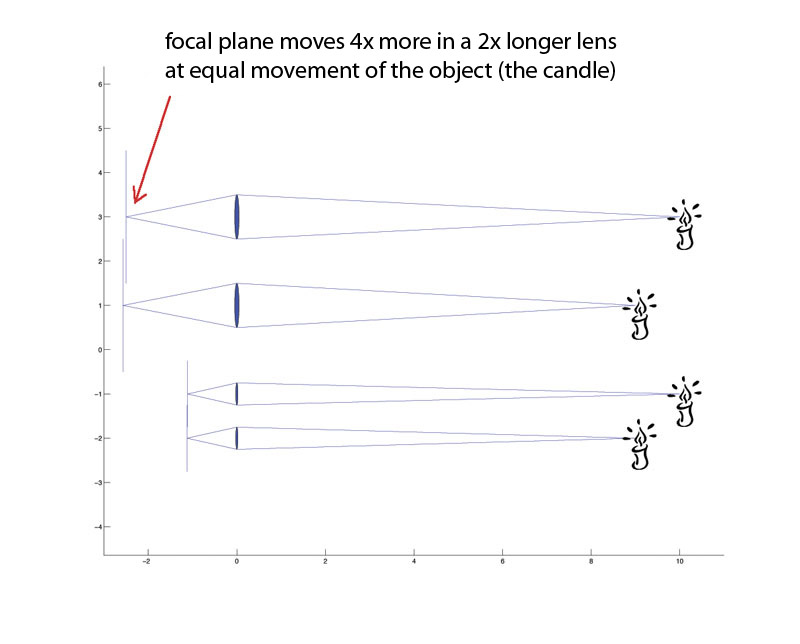
(This figure is made using the lens formula and constructed graphically using MatLab, so it is not just a sketch)
When the focal plane moves 4 times more, the size of projection of a pointsource becomes 4 times larger when out of the film plane, so DOF is four times smaller when doubling focal length. Remember: the size of the pointsource image has to remain within a given circle of confusion, given the sensor size.
So this explains point [1].
Point [2], DOF growing when you grow sensor size is simple: The circle of confusion in a larger sensor is larger in diameter, since for the final image, less magnification is needed. This relation is linear and not inverse quadratic as in point [1].
The dependence of the circle of confusion (diameter in mm) and sensor size can be for instance:

Last edited by Lindolfi; 4th July 2008 at 02:53 PM.

 Reply With Quote